The Balance of Life: Beyond Simple Calcite in Post-RO Remineralization
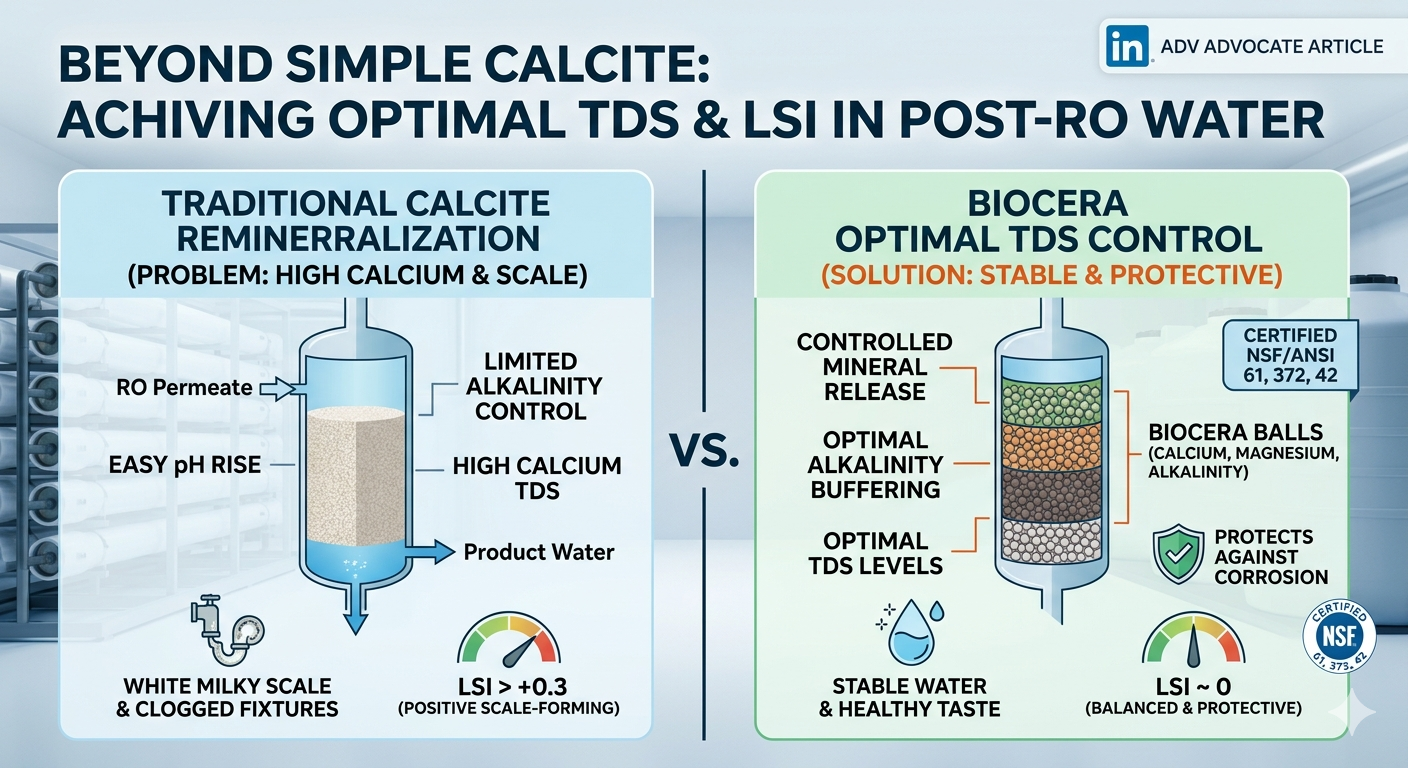
For decades, the water industry has relied on calcite contactors as the "easy" fix for acidic Reverse Osmosis (RO) permeate. While calcite effectively raises pH, it often creates a secondary headache: white milky scale and excessive Calcium TDS. High calcium levels without proper alkalinity buffering lead to aesthetic issues, clogged fixtures, and inconsistent water quality (Nelson & De Luca, 2022).
The true challenge of post-RO treatment is not just adding minerals—it is achieving chemical stabilization.
The Science of Stabilization: LSI and Alkalinity
Water stability is measured by the Langelier Saturation Index (LSI). An LSI of zero represents perfectly balanced water.
Negative LSI (< -0.3): The water is "hungry" (corrosive), attacking metal pipes and leaching lead or copper into the supply (Robinson, 2024).
Positive LSI (> +0.3): The water is oversaturated, leading to the precipitation of calcium carbonate (CaCO_3)—the notorious white scale (Nelson & De Luca, 2022).
Pure RO water typically has a severely negative LSI. Simply dumping calcium into the system via calcite often overshoots the target, creating a high-calcium environment that still lacks the alkalinity (buffering capacity) needed to maintain a stable pH (Florida Water Resources Journal, 2009).
The Biocera Solution: Optimal TDS & Corrosion Control
Biocera Optimal TDS Control moves beyond simple mineralization. By utilizing a sophisticated blend of ceramic media—certified to NSF/ANSI 42, 61, and 372—we ensure the water is not only safe but chemically harmonious.
1. Controlled Mineral Release
Unlike raw calcite, Biocera balls provide a controlled release of essential minerals (Ca, Mg, K, Na). This prevents "TDS spikes" and ensures the water remains within the Protective Layer Formation zone (3 < CCPP < 10\text{ mg/L}), where a microscopic, non-scaling film protects infrastructure without causing buildup (Nelson & De Luca, 2022).
2. Alkalinity as a Shield
Sufficient alkalinity is the "shock absorber" for water. It prevents rapid pH fluctuations and neutralizes the corrosive nature of the RO permeate. Biocera’s technology focuses on the calco-carbonic equilibrium, balancing calcium hardness and bicarbonate alkalinity to deliver a stable, non-aggressive product (Nelson & De Luca, 2022).
3. Certified Safety and Sustainability
NSF 61/372: Guaranteed lead-free and safe for all drinking water components.
NSF 42: Verified for aesthetic improvement, ensuring the water tastes as good as it looks.
Conclusion
True water quality after reverse osmosis requires a transition from "mineral addition" to "stabilization management." By optimizing LSI and alkalinity, we protect our plumbing, eliminate the "milky water" problem, and provide the healthy, antioxidant-rich water the world deserves.
#WaterTreatment #ReverseOsmosis #Biocera #LSI #Sustainability #WaterScience #NSF#WQA
References
Nelson, N., & De Luca, A. (2022). Remineralization and Stabilization of Desalinated Water. Pathways and Challenges for Efficient Desalination. https://doi.org/10.5772/intechopen.99458 Cited by: 3
Robinson, A. L. (2024). Potential corrosivity of untreated groundwater in Louisiana. Scientific Investigations Report. https://doi.org/10.3133/sir20245035 Cited by: 1